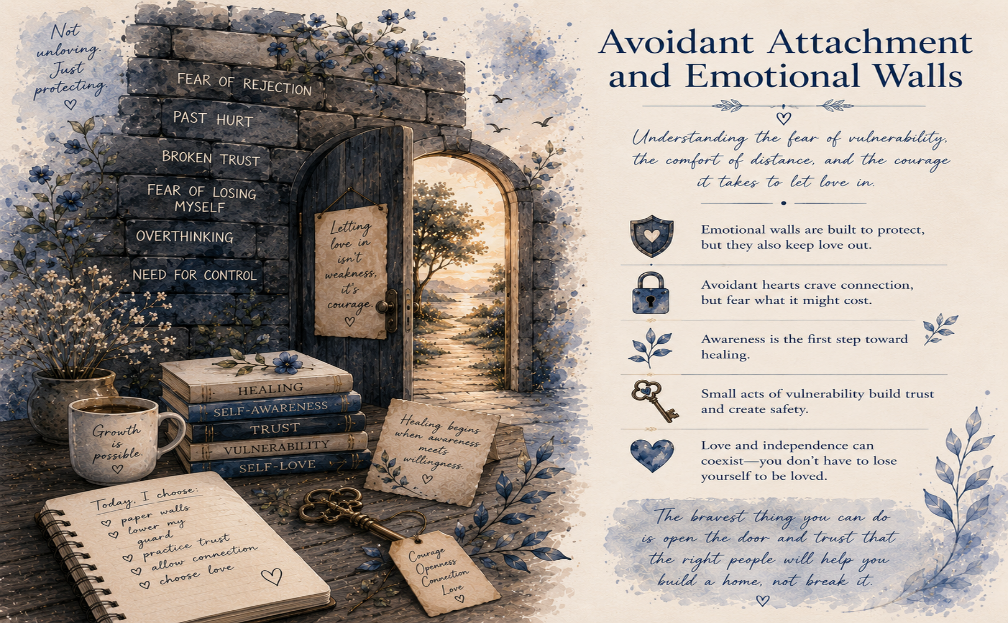
Understanding the fear of vulnerability, the comfort of distance, and the courage it takes to let love in.
Some people are afraid of being alone. Others are afraid of getting too close.
Avoidant attachment is often misunderstood as a lack of love or commitment. In reality, many people with avoidant tendencies care deeply, but they simply struggle to feel safe when relationships become emotionally intimate. What appears to others as distance or disinterest is often a quiet battle between the desire for connection and the fear of losing themselves.
Emotional walls are rarely built without reason. They are often the result of past experiences relationships that ended painfully, trust that was broken, or moments when vulnerability was met with rejection instead of understanding. Over time, the heart learns to protect itself. It tells us that if we keep someone at a distance, they can’t hurt us. While this may feel like safety, it often becomes a prison of our own making.
People with avoidant attachment don’t necessarily fear love; they fear what love might cost them. They worry that commitment means losing their independence, sacrificing their identity, or becoming emotionally dependent on someone else. As relationships deepen, these fears can become overwhelming. They may withdraw, create emotional distance, or convince themselves that leaving is better than staying.
To the person on the other side, this can be incredibly confusing. One day, everything feels warm and connected. The next, it seems as though an invisible wall has appeared. The love may still be there, but fear has become louder than affection.
The difficult truth is that emotional distance doesn’t protect us from pain it often creates the very loneliness we were trying to avoid. By pushing people away before they have the chance to leave, we never allow ourselves to experience the security and consistency that healthy relationships can offer. We end up proving our greatest fear to ourselves: that we will always be alone.
Healing begins with awareness.
Recognizing avoidant patterns isn’t about assigning blame or labeling ourselves as broken. It is about understanding why we react the way we do and realizing that our past doesn’t have to dictate our future. Fear may explain our behavior, but it does not have to define it.
Learning to let others in doesn’t happen overnight. It happens through small acts of courage sharing your thoughts instead of keeping them hidden, expressing your feelings even when they feel uncomfortable, and allowing someone to see the parts of yourself you’ve spent years protecting. Vulnerability may feel unfamiliar, but it is also the foundation upon which trust is built.
Equally important is finding people who respect your pace. Healthy relationships are not about forcing someone to open up before they’re ready. They are built through patience, consistency, and understanding. The right person won’t demand perfection or expect you to overcome every fear immediately. Instead, they create an environment where vulnerability feels safe rather than threatening.
Perhaps the most important lesson is realizing that love and independence are not opposites. You can care deeply for someone without losing yourself. You can commit to a relationship while still pursuing your own dreams, protecting your individuality, and maintaining your sense of identity. Healthy love doesn’t ask you to become less of yourself it encourages you to become more.
In the end, emotional walls may temporarily keep pain out, but they also keep joy, connection, and love at a distance. The bravest thing an avoidant heart can do is not to remain guarded forever, but to slowly open the door and trust that the right people won’t slam it shut hold it open.